
Rates, Elections and Market Volatility Remain in Focus
October and early November have given investors plenty to consider. Interest rates remain elevated, energy markets continue to influence the inflation outlook, and the November 3 midterm elections have been followed by renewed volatility, particularly among large technology companies.
These developments can move markets quickly. For long-term investors, the more important question is whether they are materially changing the economic and business fundamentals underlying a financial plan.
The Fed and Interest Rates
At its October meeting, the Federal Reserve held the federal funds rate at 3.75%–4.00%, following a quarter-point increase in September. Economic activity continues to expand, while inflation remains elevated, leaving policymakers to balance growth against continued price pressures.
For investors, the bigger question may now be how long rates remain elevated rather than what happens at any single Fed meeting.
10-Year U.S. Treasury Yield
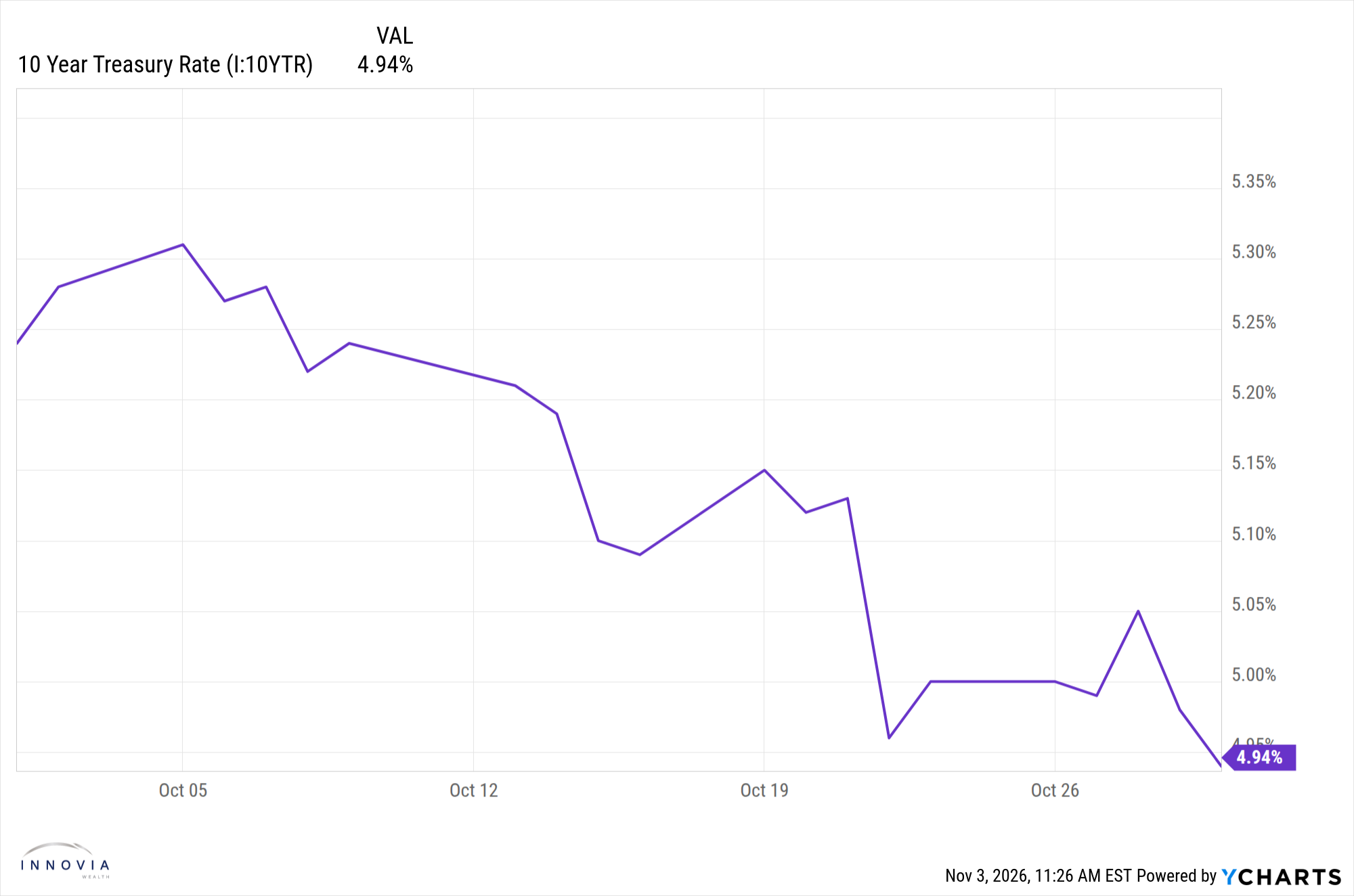
Treasury yields remain an important indicator of the broader borrowing and investment environment. Higher yields can improve income opportunities in parts of the bond market, while also increasing financing costs for businesses and households.
Energy Remains Part of the Inflation Picture
The conflict involving Iran continues to affect global energy markets. Higher crude, freight, and transportation costs can move through supply chains and eventually influence prices for businesses and consumers.
For investors, the connection is important because persistent energy pressures could complicate the inflation picture and influence how long interest rates remain elevated.
Looking Through Recent Market Volatility
Market volatility increased following the November 3 midterm elections. Initial relief around a clear election outcome quickly shifted toward concerns about large technology companies, artificial intelligence, and the continued buildout of data centers.
Technology stocks have been at the center of the recent decline. Nvidia, one of the companies most closely associated with the AI infrastructure buildout, has fallen roughly 25% from its October high as investors question whether permitting, financing, power availability, and political opposition could slow new data-center development.
The distinction is important. The current concern is largely about how quickly AI infrastructure can be built, rather than evidence that demand for AI has disappeared. Nvidia’s November 17 earnings report may provide another look at AI spending, customer demand, and whether infrastructure constraints are beginning to affect the underlying business.
Data-center development could slow in certain communities as questions around power, water, permitting, and local infrastructure are addressed. That does not necessarily mean development stops. Investment may shift toward areas better equipped to accommodate it, while existing infrastructure could become more valuable if new capacity becomes harder to build.
More broadly, there are still reasons to keep the current volatility in perspective. Corporate earnings expectations remain strong, businesses and governments continue to invest significant capital, unemployment remains low, and the U.S. economy continues to grow. If growth were to weaken materially, lower interest rates could also provide some offset.
History provides useful context as well. Since 1950, the S&P 500 Index has been positive 12 months after every midterm election, with an average return of approximately 15%. Index returns are shown for illustration only, do not reflect fees or expenses, and an index cannot be invested in directly. Past performance does not predict future results, but this history reinforces the importance of separating short-term political and market reactions from longer-term investment decisions.
Markets Continue to Navigate Competing Signals
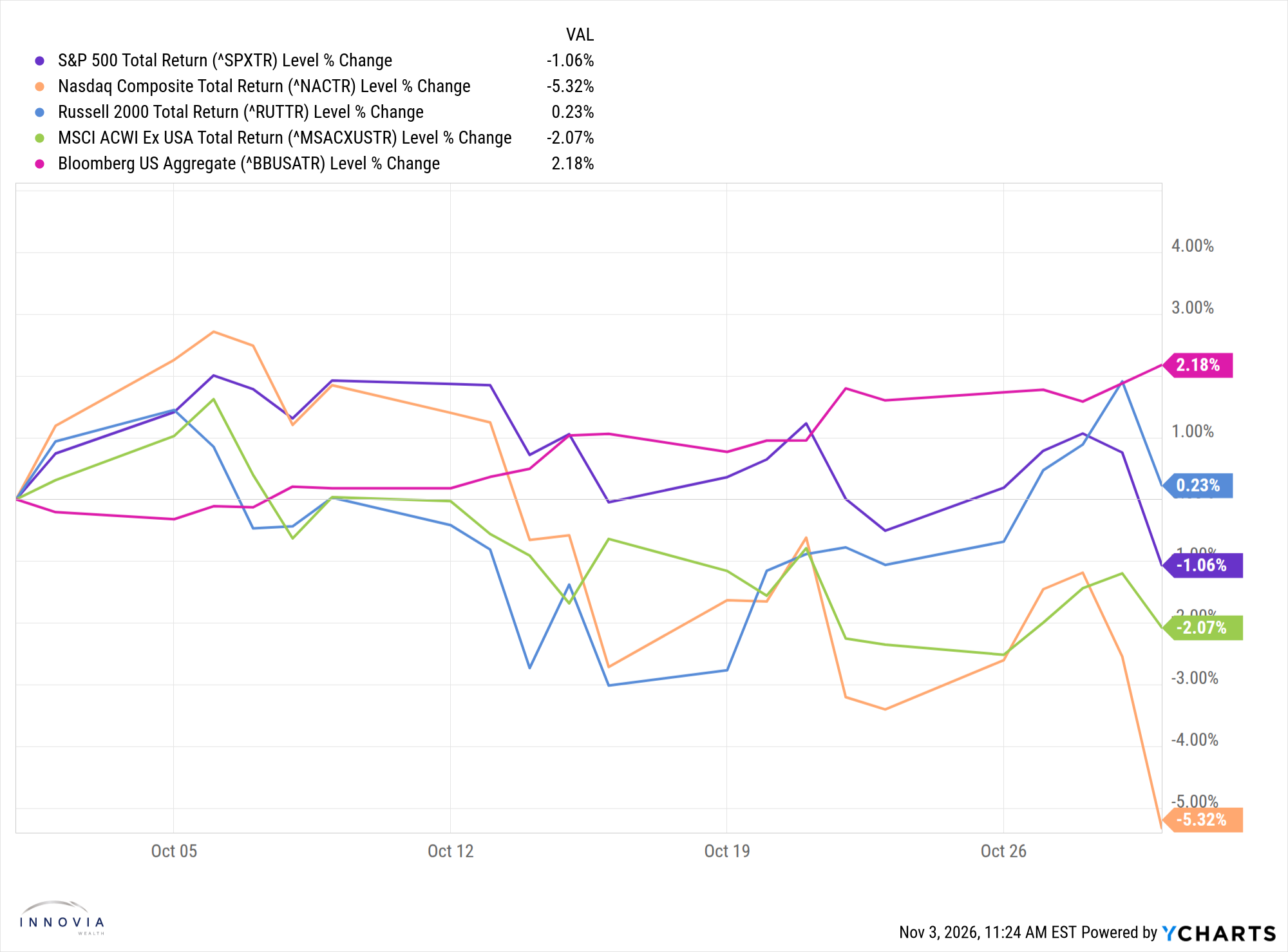
Markets are weighing economic growth, corporate earnings, inflation, interest rates, policy, and rapidly changing expectations around technology simultaneously.
That puts greater importance on fundamentals. In equities, valuations, earnings, cash flows, and balance-sheet strength matter. In fixed income, higher yields may continue to create income opportunities, while duration and credit quality deserve attention.
For business owners and executives with concentrated exposure to a company or industry, periods like this are also a reminder to consider how that exposure fits within the broader financial plan.
What We're Watching
Interest rates: How inflation and economic growth influence the Fed’s next steps.
Corporate fundamentals: Whether earnings and business investment continue to support the broader economic picture.
AI and data centers: Whether infrastructure constraints begin to meaningfully affect investment and demand.
Energy: How continued disruption in the Middle East affects commodity prices and inflation.
Policy: How the election results translate into actual tax, regulatory, and fiscal policy.
Perspective
Recent volatility is a reminder that markets can adjust expectations much faster than the underlying economy changes.
The useful question for long-term investors is not simply why the market is moving today. It is whether the underlying economic and business fundamentals have changed enough to warrant a change in the financial plan.
Interest rates remain elevated. Energy markets remain sensitive to geopolitical developments. Technology companies are adjusting to new questions surrounding AI infrastructure. There may be more volatility as investors work through those issues.
Our focus remains on separating short-term market reactions from longer-term developments and keeping investment decisions connected to each client's broader objectives.
If recent volatility has raised questions about your portfolio or financial plan, please reach out to your Innovia team.
Disclosure:
This content is for informational and educational purposes only. It is not intended as, and should not be considered, personalized investment advice, a recommendation to buy or sell any security, or a solicitation to engage in any investment strategy.
The views and opinions expressed are those of Innovia Wealth as of the date published and are subject to change without notice. Forward-looking statements, including market and economic forecasts, are based on current assumptions and expectations and are not guarantees of future results.
Innovia Wealth is an SEC-registered investment adviser; registration does not imply any level of skill or training. Innovia does not provide legal or tax advice, please consult the appropriate professional for those matters.
All investments involve risk, including the possible loss of principal. Past performance is not a guarantee of future results.
Any index or benchmark performance presented is provided for illustrative purposes only. Indexes are unmanaged, cannot be invested in directly, and do not reflect the deduction of fees or expenses.
Content on this channel is intended for a U.S. audience. Advisory services are only offered to clients or prospective clients where Innovia Wealth and its representatives are properly licensed or exempt from licensure.