
Summary
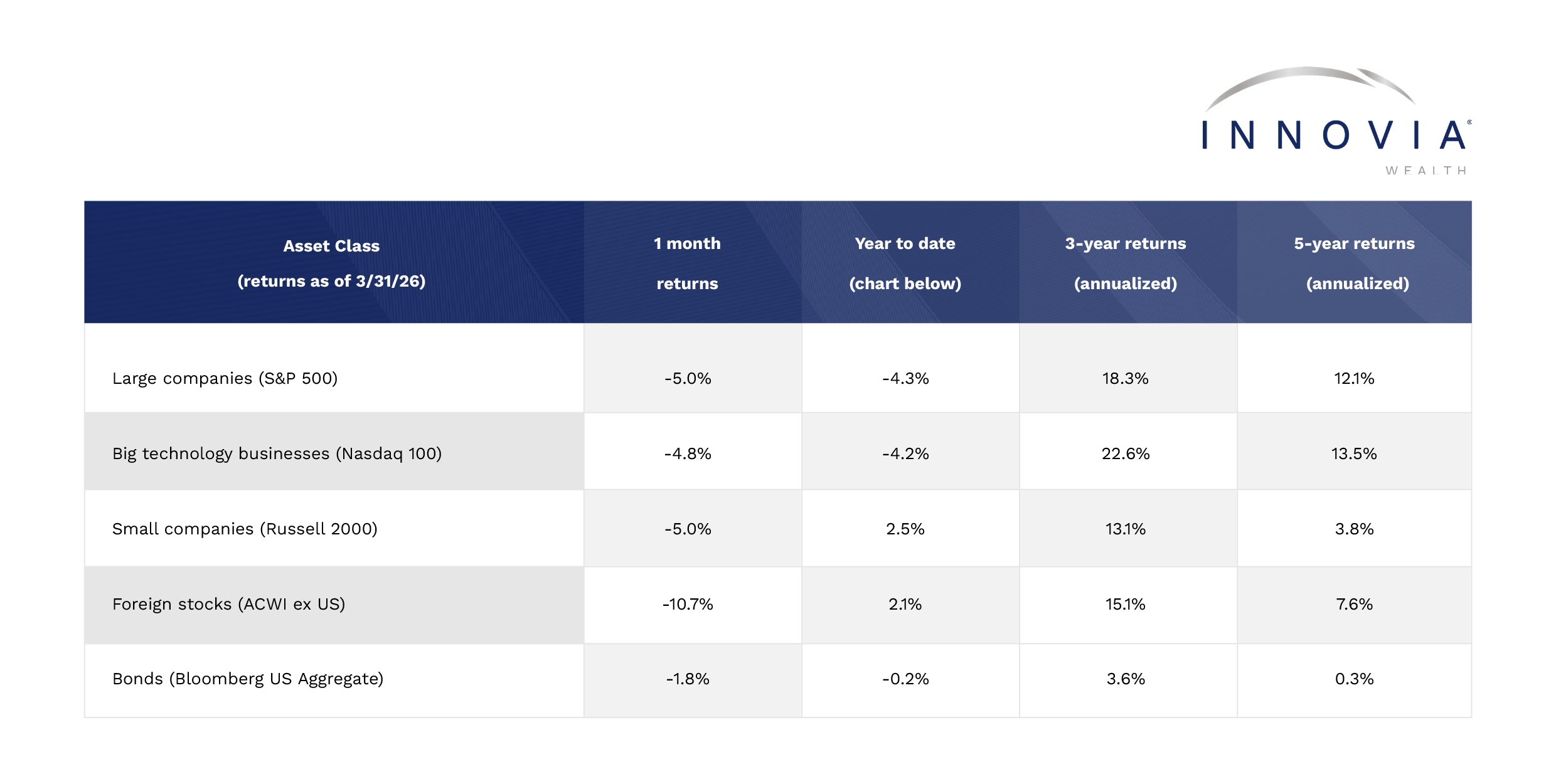
Markets declined in March as the escalation of conflict with Iran—particularly the closure of the Strait of Hormuz—triggered a sharp rise in energy prices and a broad shift to risk-off sentiment. While economic growth remains moderate and corporate earnings expectations are strong, geopolitical risks now dominate the outlook. In this environment, we continue to emphasize diversification, disciplined rebalancing, and balanced exposure across asset classes.
March Market Update: The Conflict in Iran Weighs on Markets
The United States and Israel launched coordinated strikes against Iran at the end of February, significantly escalating tensions in the region. The conflict intensified rapidly, resulting in the closure of the Strait of Hormuz—a critical global trade chokepoint.
Roughly 20% of global oil consumption, more than 20% of liquefied natural gas, and significant portions of fertilizer and sulfur exports transit through the Strait. Its closure has driven a sharp increase in commodity prices, with ripple effects across global markets.
Given the existential nature of the threat to the Iranian regime, the conflict has broadened, including retaliatory strikes across much of the Gulf region. For the global economy, the key issue is duration: the longer the Strait remains closed, the greater the disruption to supply chains, industrial production, and economic activity. A short-lived conflict would likely result in only a modest slowdown, while a disruption lasting months could push the global economy into recession.
Market Performance: Broad-Based Declines
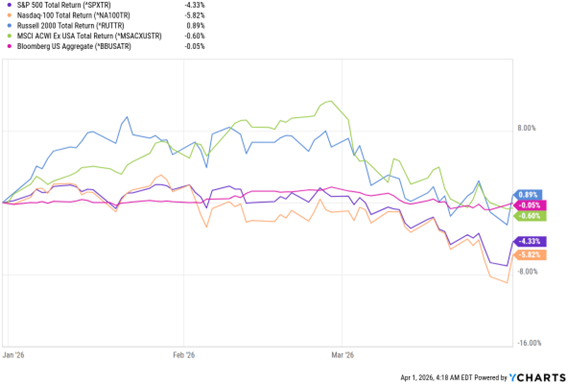
Earlier in the year, international and small-cap equities had been leading market performance, while large-cap and technology stocks were relatively flat. This dynamic unwound sharply in March as markets reacted to escalating geopolitical risk.
International equities declined as the U.S. dollar strengthened in a flight to safety and higher commodity prices weighed on import-dependent economies.
Small-cap stocks and fixed income came under pressure as interest rates rose, reflecting expectations that the Federal Reserve may delay rate cuts—or even tighten policy—in response to renewed inflation pressures.
Large-cap and technology stocks, already facing questions around artificial intelligence-related expectations, weakened further as investors priced in the potential for slower economic growth.
Energy was the primary beneficiary, supported by the surge in oil and gas prices.
The Economy: Stable Growth, Mixed Signals
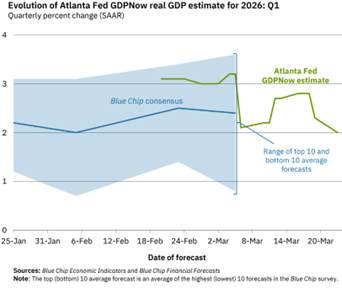
The U.S. economy is expected to have grown at approximately 2.0% in the first quarter of 2026, broadly in line with 2025. Growth continues to be driven by consumer spending and investment in artificial intelligence infrastructure.
Household income growth remains solid, supporting consumption. However, job creation has slowed over the past year, indicating a more cautious labor market.
The Federal Reserve faces a difficult balancing act. Inflation has proven “sticky,” and the added pressure from higher energy prices complicates the outlook. At the same time, the labor market is gradually softening.
If inflation remains elevated, the Fed may need to maintain or even modestly increase rates.
If economic activity weakens more materially, rate cuts could follow more quickly.
Earnings Outlook: Strong but Likely to Normalize
Corporate earnings remain a key support for equity prices. Current expectations call for earnings growth of approximately 16% in 2026 and 17% in 2027—well above the long-term historical average of roughly 6% annually.
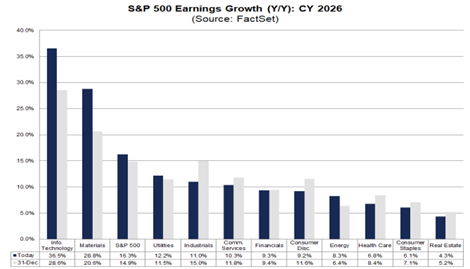
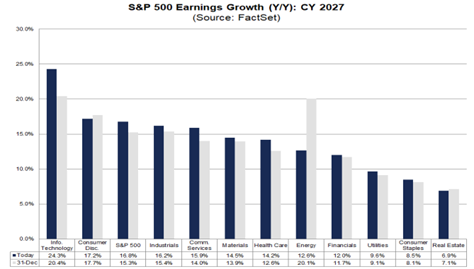
While this strength is encouraging, history suggests that elevated growth rates tend to revert toward the mean over time. The rapid pace of innovation—particularly in artificial intelligence—has led some to argue that this cycle may be different.
However, intense competition across the AI landscape—including firms such as OpenAI, Anthropic, Google, Microsoft, Meta, Nvidia, Amazon, and others—suggests that excess returns may be competed away over time. While AI may drive meaningful productivity gains, a more normalized growth trajectory remains the prudent base case.
Geopolitical Risks and Potential Outcomes
Geopolitical developments are now the dominant driver of market risk:
Middle East: A prolonged closure of the Strait of Hormuz would likely trigger a global recession. A constructive resolution, potentially involving a less adversarial Iranian regime, could significantly reduce long-term risk.
Ukraine: The conflict continues with incremental Russian gains. Without a meaningful shift in external support or internal dynamics, a prolonged stalemate appears most likely.
China and Taiwan: This remains the most significant tail risk. With the U.S. focused on the Middle East, the possibility of increased pressure on Taiwan cannot be dismissed. Conversely, improved U.S.-China relations could meaningfully reduce global risk.
Artificial intelligence also presents both upside and downside uncertainty, with outcomes ranging from transformative productivity gains to labor displacement and broader societal challenges.
Given these uncertainties, attempting to predict specific outcomes is less productive than maintaining a disciplined, risk-aware investment approach.
Investment Strategy and Outlook
With geopolitical risks elevated, diversification and disciplined rebalancing are more important than ever. Attempting to predict short-term outcomes in this environment is inherently unreliable.
We continue to advocate for broad diversification across asset classes:
Equities: While large technology companies remain expensive, their growth potential—particularly in AI—supports maintaining meaningful exposure. To balance this, we favor allocations to international, small-cap, and value-oriented equities, where valuations are more attractive.
Fixed Income: We continue to emphasize mortgage-backed securities and selectively chosen corporate bonds. Treasuries provide important downside protection in risk-off environments, while municipal bonds offer attractive after-tax yields for taxable accounts.
Private Markets: Private investments can enhance returns but require careful consideration of liquidity. We recommend these exposures when investors have sufficient liquid assets and a clear understanding of the trade-offs. Manager selection remains critical, particularly in credit-focused strategies.
Investing is not about predicting every geopolitical event or market move. Instead, it is about consistently applying sound principles—diversification, valuation discipline, and thoughtful risk management—to navigate uncertainty and achieve long-term objectives.
Disclaimers:
This material is provided for informational and educational purposes only and does not constitute investment advice, a recommendation, or an offer or solicitation to buy or sell any security or investment strategy. Any opinions expressed are as of the date of publication and are subject to change without notice.
All investing involves risk, including the possible loss of principal. There can be no assurance that any investment strategy will be successful or that investment objectives will be achieved. Past performance is not indicative of future results.
Index performance is provided for illustrative purposes only. Indexes are unmanaged and do not reflect the deduction of advisory fees, transaction costs, or other expenses. Investors cannot invest directly in an index.
Any forward-looking statements, projections, or estimates are based on current assumptions and expectations and are subject to significant uncertainties and changes in market conditions. Actual results may differ materially.
This commentary is not intended to provide individualized investment advice and does not take into account the particular investment objectives, financial situation, or needs of any specific investor. Investors should consult with a qualified financial professional before making any investment decisions.