
Summary
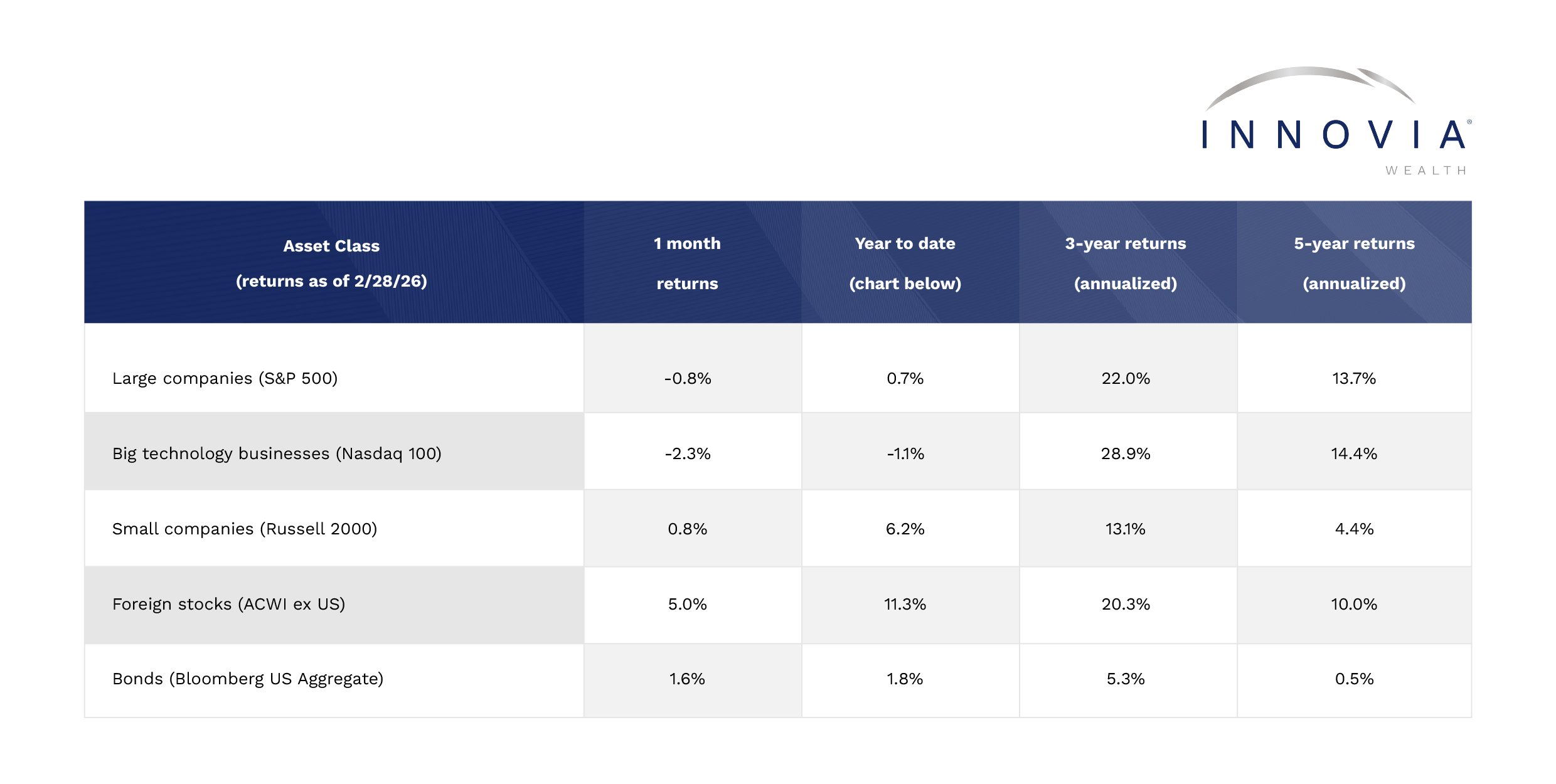
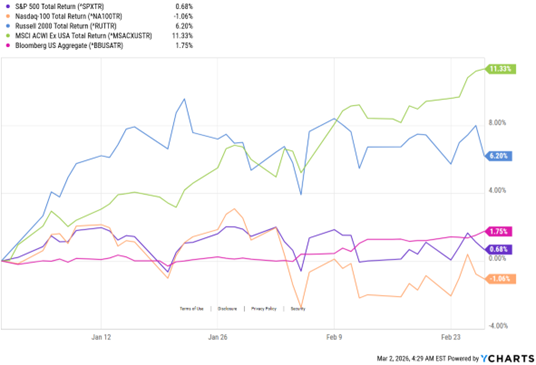
February saw international equities continue to outperform—driven largely by strength in the global semiconductor cycle—while U.S. technology, particularly software stocks, came under pressure as investors reassessed how rapidly advancing artificial intelligence (AI) could disrupt established business models. At the same time, bonds delivered solid returns as long-term interest rates declined on signs of moderating economic momentum and a modest shift toward defensive positioning. Markets also navigated significant policy and legal developments around U.S. trade measures, alongside softer-than-expected U.S. growth data for late 2025 and still-optimistic earnings expectations for 2026 and beyond—reinforcing both the opportunities created by innovation and the importance of maintaining a diversified investment approach.
February Market Update: International Stocks Impress and Bonds Bounce
International stocks posted another strong month in February, even as the U.S. dollar edged slightly higher. Much of the strength came from expectations of rising earnings at Korean memory-chip leaders such as Samsung Electronics and SK Hynix, both seen as major beneficiaries of AI data-center investment.
By contrast, U.S. technology shares—particularly software-oriented companies—pulled back. Investors are increasingly focused on how rapid advances in AI could disrupt long-established business models at firms such as AppLovin, Intuit, and Palantir Technologies.
Bonds Rally as Yields Decline
Bonds had a strong month as long-term interest rates fell from roughly 4.3% to 4.0%. Because bond prices move inversely to yields, this decline supported bond returns.
Yields eased on signs that economic growth may be slowing, and on a modest “flight to safety” following weakness in equity markets—particularly in software-related technology stocks. In addition, markets appeared encouraged by the prospective appointment of Kevin Warsh as Chair of the Federal Reserve, given his reputation for maintaining a firm focus on inflation rather than easing policy by default.
Trump’s Tariffs Ruled Unconstitutional
The Supreme Court of the United States ruled in late February that President Trump’s use of the International Emergency Economic Powers Act to impose certain tariffs was unconstitutional.
While the decision had been widely anticipated, it leaves open important questions about how previously imposed tariffs will be unwound or refunded, and how the administration may pursue alternative legal authorities for future tariffs (for example, under Section 122 of the Trade Act of 1974). The ruling removes some uncertainty for markets and businesses, but it also introduces new ambiguity around the practical path forward.
We view the market’s initially positive reaction as evidence that the decision—and the administration’s likely response using alternative tariff authorities—had largely been priced in. Over the longer term, the ruling is constructive in demonstrating the resilience of U.S. institutions (checks and balances). In the near term, however, it is likely to introduce fresh uncertainty for corporate planning and economic decision-making.
Strong Finish to 2025 and Rising Expectations for 2026
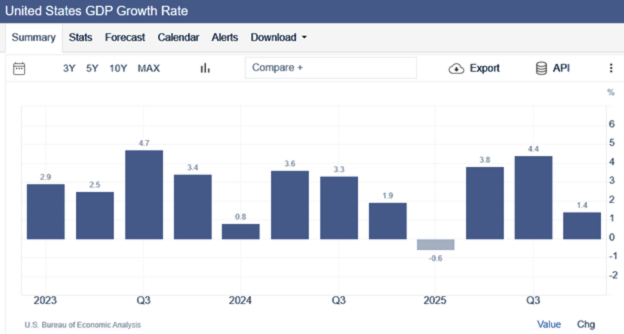
U.S. economic growth came in at a disappointing 1.4% in the fourth quarter of 2025, well below the roughly 3% consensus expectation. The shortfall reflected solid consumer spending that was significantly offset by a much larger-than-expected decline in government expenditures.
Taken together, recent data now point to approximately 2.3% growth for full-year 2025—still comfortably stronger than other major developed markets such as Europe (about 1.4%) and Japan (about 0.9%).
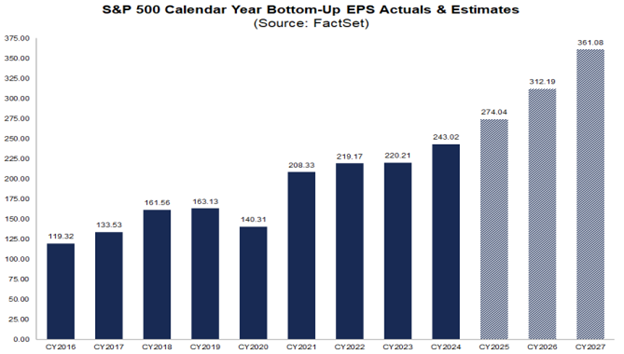
Looking ahead, broad economic growth in early 2026 is expected to rebound to roughly 3% in the first quarter. More important for equity investors, corporate earnings growth for 2026 and 2027 is currently forecast at approximately 14% and 16%, respectively. While these estimates are unlikely to be precisely correct and actual results may differ materially, they help explain why market valuations remain elevated.
Technology Disruption and Geopolitical Strife
Recent declines in parts of the technology sector—particularly software—alongside continued strength in semiconductors are typical during periods of technological disruption. The eventual winners will look obvious in hindsight, but from today’s vantage point, the outcome remains highly uncertain. Major technology revolutions such as AI occur every decade or so, permanently reshaping industries, yet they rarely make investing straightforward. If anything, this environment reinforces the value of a diversified approach.
Geopolitical change is another powerful and recurring force. Political alignments evolve, economic laggards can become leaders, and the global order shifts in uneven steps. Even when investors correctly identify the direction of change, accurately timing it—and anticipating first-, second-, and third-order effects—remains extraordinarily difficult. This reality further strengthens the case for diversification across asset classes, countries, and industry sectors.
Investment Strategy and Outlook
With a generally supportive economic backdrop and strong earnings growth offset by ongoing technological and geopolitical risks, we continue to advocate a broadly diversified investment strategy. We believe it is prudent to spread risk across liquid (public) and illiquid (private) investments, to balance fixed-income allocations with higher-return-oriented equities where appropriate, and to maintain exposure to both large and small companies across multiple geographical regions.
This approach acknowledges what we cannot know while relying on what has historically worked over long investment cycles. It may be less exciting than a concentrated bet, but prudence rarely makes for titillating cocktail-party conversation.
Please let us know if you have any questions about current market conditions or our investment positioning.
Disclaimers:
This material is provided for informational and educational purposes only and does not constitute investment advice, a recommendation, or an offer or solicitation to buy or sell any security or investment strategy. Any opinions expressed are as of the date of publication and are subject to change without notice.
All investing involves risk, including the possible loss of principal. There can be no assurance that any investment strategy will be successful or that investment objectives will be achieved. Past performance is not indicative of future results.
Index performance is provided for illustrative purposes only. Indexes are unmanaged and do not reflect the deduction of advisory fees, transaction costs, or other expenses. Investors cannot invest directly in an index.
Any forward-looking statements, projections, or estimates are based on current assumptions and expectations and are subject to significant uncertainties and changes in market conditions. Actual results may differ materially.
This commentary is not intended to provide individualized investment advice and does not take into account the particular investment objectives, financial situation, or needs of any specific investor. Investors should consult with a qualified financial professional before making any investment decisions.