
Summary
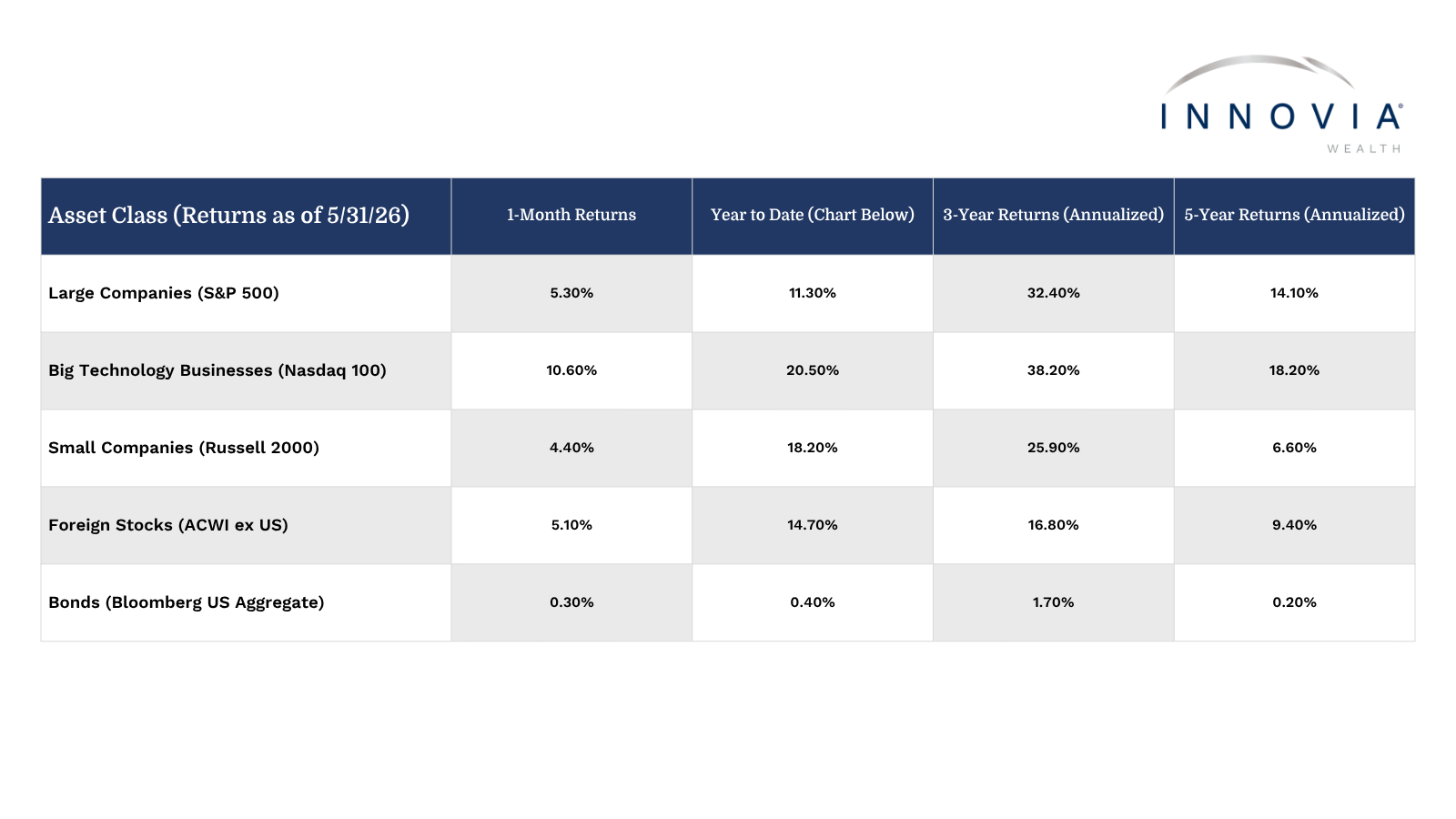
Markets delivered another strong month, led once again by large U.S. technology companies whose strong earnings appeared to outweigh geopolitical concerns and rising inflation risks. While equities—particularly AI-driven sectors—continued to advance, higher bond yields pressured fixed income and more interest rate-sensitive areas of the market. The U.S. economy remains resilient, supported by consumer spending and significant investment in AI infrastructure. However, inflation has emerged as the primary risk to both growth and market stability, reinforcing the importance of diversification, disciplined rebalancing, and prudent risk management.
Market Performance: Technology Leads While Bonds Struggle
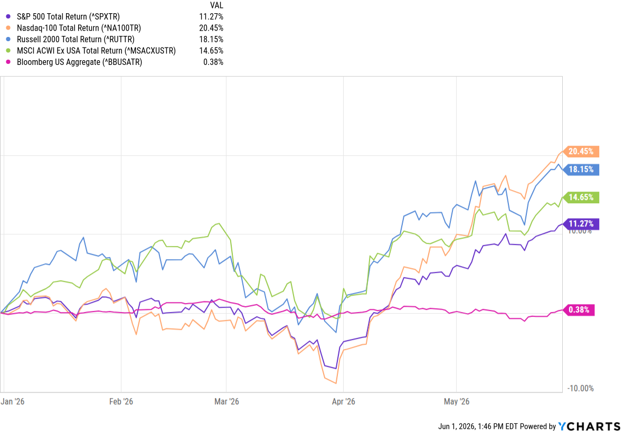
Strong earnings results from large technology companies appeared to outweigh most of the negative news coming out of the Middle East this month. As a result, the more technology-weighted areas of the market performed very well, even as interest rate-sensitive sectors struggled.
Large technology stocks finished the month up 8%, while large U.S. companies more broadly—some with significant AI exposure—gained 4%. International equities rose 3%, driven largely by surging chip manufacturers in Taiwan and South Korea, which offset more modest returns from other holdings. Small-cap companies were also up 3%, while fixed income declined 0.5%, reflecting continued pressure from higher interest rates.
The 10-year U.S. Treasury yield—a global benchmark for long-term investment valuations—rose from 4.4% to 4.6% as higher inflation expectations, rising commodity prices, and concerns over increased defense spending triggered a bond market sell-off. It is somewhat unusual for long-term bonds to decline while equities rise, which may reflect growing disagreement within markets about the economic outlook.
The Economy: Robust, For Now
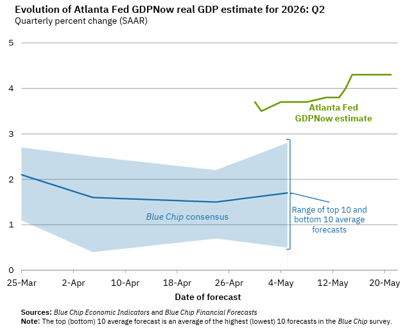
First-quarter GDP growth came in at 2%, above expectations. Much of the upside surprise was driven by strong investment in AI infrastructure, while consumers continue to spend at a healthy pace. Early estimates for second-quarter growth are running at 4.3%, suggesting the economy remains resilient, although economic conditions and monetary policy expectations can change.
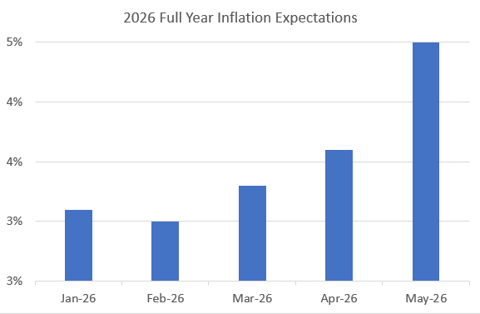
Economists began the year expecting inflation to settle near 3% in 2026, but conflict in the Middle East has pushed those expectations higher. Based solely on current trends and inflation comparisons from last year, it is increasingly possible that inflation could rise further by year-end. Such an outcome could negatively affect both economic growth and returns across equities and fixed income.
Source: Cornerstone Portfolio Research
Inflation has begun to weigh on consumer sentiment, though not yet enough to meaningfully slow spending. It is, however, eroding real wage growth, which could become a headwind for future consumer demand.
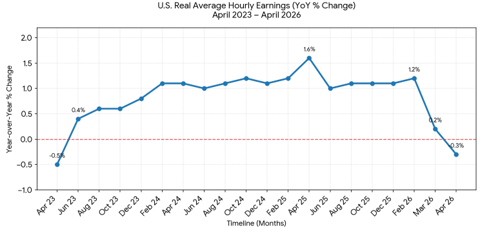
Source: Cornerstone Portfolio Research, Gemini AI
On a more positive note, the Federal Reserve now has a new Chairman, Kevin Warsh, which may reduce policy uncertainty over the coming years. At the same time, AI-driven productivity gains and infrastructure investment remain significant economic tailwinds. Despite substantial geopolitical challenges, the U.S. economy continues to show more areas of strength—provided inflation does not broaden into a more persistent problem.
Earnings Outlook: U.S. Technology Continues to Impress
With more than 90% of large U.S. companies having reported quarterly results, earnings per share are up 28% from a year ago. Consensus expectations for 2026 and 2027 are for full-year growth of 23% and 15%, respectively above the historical average of approximately 6%.
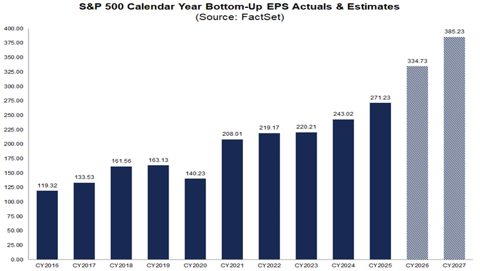
Source: FactSet
As has been the case since 2023, much of the credit belongs to the largest technology companies, which continue to exceed some expectations—and, to some extent, the traditional economic assumption that competition eventually reduces profitability and slows growth.
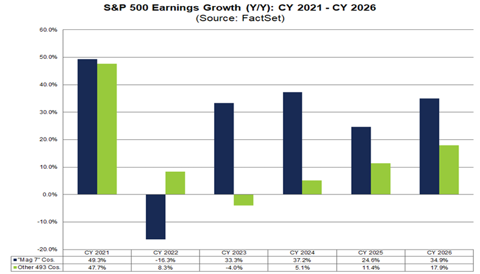
Source: FactSet
Competition among companies such as Nvidia, Apple, Google, Microsoft, Meta, Amazon, and Tesla appears to be intensifying, yet there has been little evidence so far of slower growth or reduced profit margins. Free cash flow, however, has come under some pressure due to massive capital expenditures on AI infrastructure, but not enough to significantly reduce investor interest.
Importantly, companies outside the so-called “Magnificent 7”—sometimes referred to as the “S&P 493”—are beginning to benefit from AI adoption as well, and that runway for broader productivity gains could be long.
What Could Dampen the Party?
At present, inflation appears to be a more immediate risk than geopolitics. Persistent inflation tends to reduce economic growth, weaken consumer spending, complicate business planning, and pressure the U.S. dollar. Markets do not appear to be fully pricing in this possibility, which could create downside risk for both equities and fixed income.
Geopolitical risks remain important, though investor focus has shifted somewhat from the Middle East back toward Asia. A cooling in tensions between the United States and China could improve that bilateral relationship, which would be a positive development. However, it remains uncertain how durable any such détente might be.
The upcoming U.S. midterm elections also represent a growing source of uncertainty. President Trump’s approval ratings have weakened amid concerns over another Middle East conflict, rising oil and gasoline prices, and broader inflationary pressures. A shift in congressional control could create additional domestic political friction and international policy uncertainty.
Investment Strategy & Outlook
We may sound like a broken record in continuing to advocate for diversification, disciplined rebalancing, and prudent risk management—but we believe it would be unwise to abandon a sound long-term plan unless something materially changes.
Given elevated technology valuations and ongoing geopolitical uncertainty, we continue to favor balanced allocations between equities and fixed income. We also see value in select private market exposures, which may help reduce portfolio volatility in some cases while offering the potential for attractive long-term returns.
As always, please let us know if you have any questions about the market environment or our approach to managing your investments.
Disclosures:
This content is for informational and educational purposes only. It is not intended as, and should not be considered, personalized investment advice or a recommendation to buy or sell any security. Innovia Wealth is an SEC-registered investment adviser; registration does not imply any level of skill or training. Innovia does not provide legal or tax advice—please consult the appropriate professional for those matters. All investments involve risk, including the potential loss of principal. Past performance is not a guarantee of future results. Content on this channel is intended for a U.S. audience. Advisory services are only offered to clients or prospective clients where Innovia Wealth and its representatives are properly licensed or exempt from licensure.