
Summary
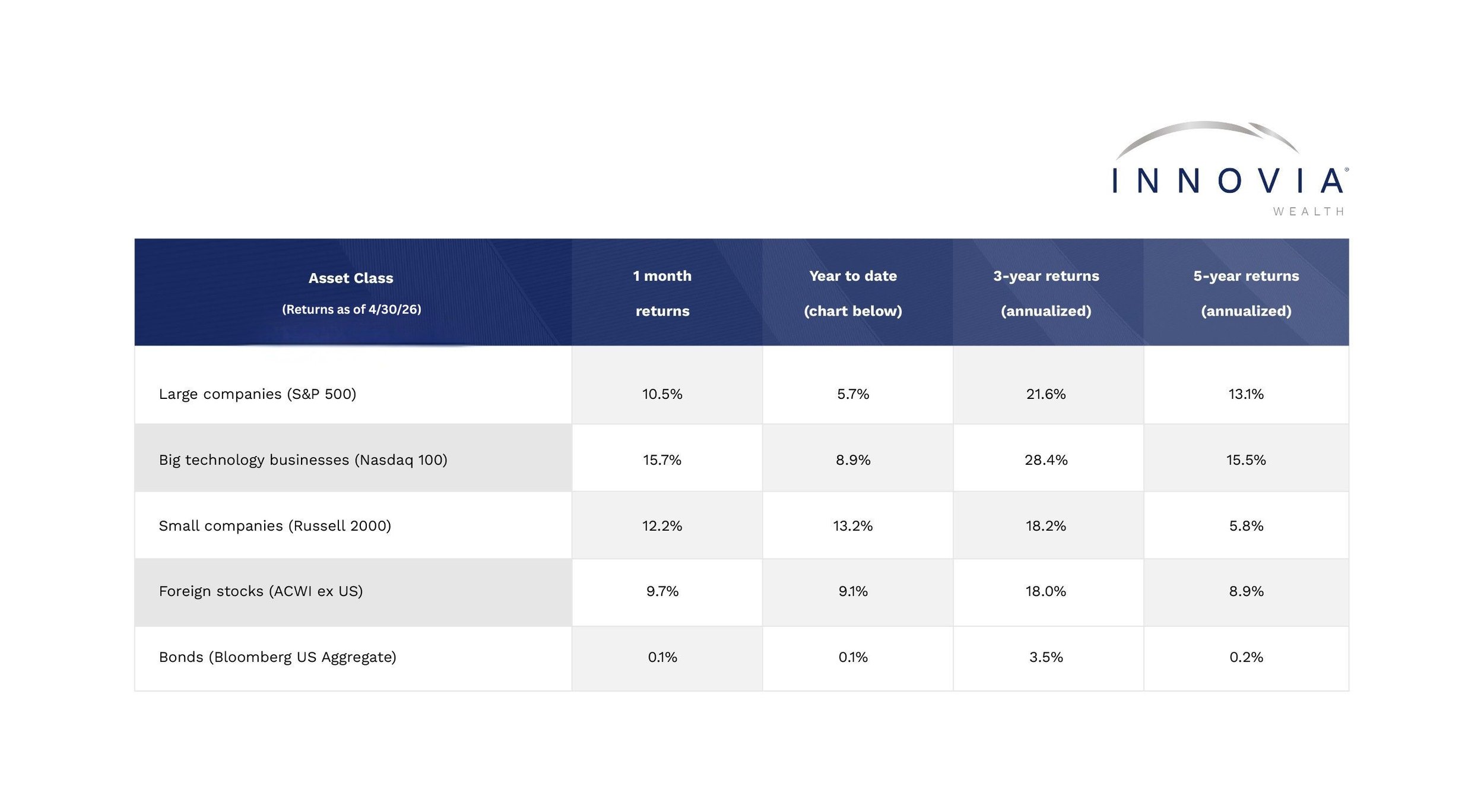
Markets have staged a sharp rebound since late March, driven less by improving fundamentals and more by easing geopolitical fears. Equity markets rallied broadly as investors responded to signs of potential de-escalation between the U.S. and Iran, highlighting how quickly sentiment can shift when geopolitical risks dominate. While fixed income also posted positive returns, the response was more muted as investors remain cautious about inflation and economic growth. Looking ahead, if geopolitical tensions continue to ease, markets are likely to refocus on the fundamentals that drive long-term returns: earnings growth, artificial intelligence, economic expansion, and trade. Our investment approach remains centered on diversification, disciplined rebalancing, and strategic asset allocation rather than attempting to predict short-term market swings.
April Market Update: Snapback
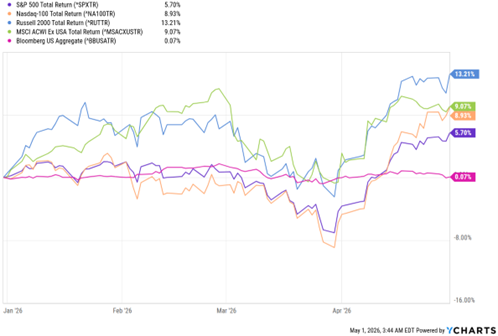
More than a week before the cease-fire agreement between the U.S. and Iran was announced, markets rebounded sharply on an unconfirmed report that Iran’s leadership was open to negotiations and possible de-escalation. Markets turned on a dime based on a rumor that only the highest levels of the U.S. or Iranian governments could have known was true or false. It was an excellent reminder of how difficult it is to successfully time market rebounds.
Since markets bottomed on March 30th, large technology companies have risen 20%, small-cap equities are up 16%, international equities have rebounded 10%, and large U.S. companies have gained 14%. These returns suggest the rally was driven more by broad relief across equity markets than by specific dynamics related to size, geography, or sector.
Fixed income securities also generated positive returns, though the rebound was far less dramatic. The U.S. dollar declined 2% and long-term interest rates climbed from 4.3% to 4.4%. Fixed income investors remain focused on economic growth and inflation, both of which face increased risks from higher commodity prices that could dampen growth while temporarily pushing inflation measures higher.
Geopolitical versus Fundamental Drivers
Since late February, markets have been influenced more by geopolitical developments than by earnings reports or economic data. While this is not business as usual, it is understandable. If the Strait of Hormuz were disrupted or the conflict expanded to involve major powers such as China or Russia, the economic consequences would be severe. In that environment, markets are right to prioritize geopolitical developments over jobs reports, inflation releases, earnings announcements, or even major technological advances.
If tensions continue to ease, investors will continue to shift their focus back earnings, AI-driven productivity gains, economic growth, and trade. In other words, geopolitics tend to drive short-term market movements, while fundamentals determine long-term investment outcomes.
If we had a crystal ball, we could trade around these events. In the real world, however, strategic allocation is far more reliable than short-term prediction.
The Economy: Moderate Growth
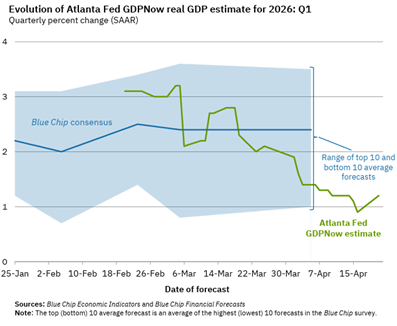
Expectations for economic growth have moderated since late February, falling from more than 3% to roughly 1% growth for the current quarter. While that sounds disappointing, it represents only a temporary slowdown and is far from recessionary.
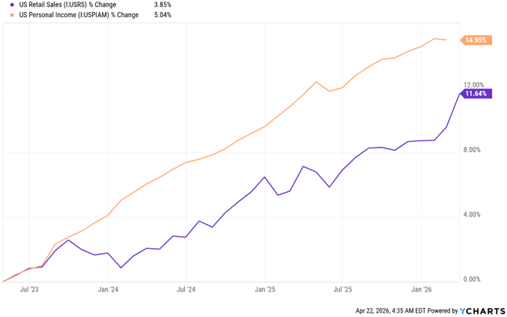
Consumer income and retail sales continue to move forward at annualized rates of approximately 5% and 3.5%, respectively. The underlying drivers of economic growth remain healthy for now.
On the labor market front, unemployment has risen to 4.3%, and job creation has plateaued, but jobless claims remain near historical lows. Unemployment is still low by historical standards, and much of the slower pace of job growth can be explained by lower immigration rather than broad labor market weakness.
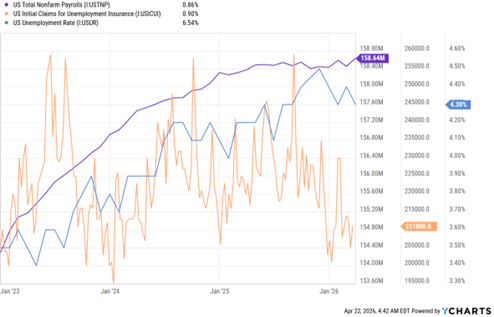
Overall, the economy is on solid—if unspectacular—footing, assuming geopolitical events do not significantly disrupt conditions.
Earnings Outlook: Strong Potential for 2026
Corporate earnings remain the primary long-term driver of equity market returns, and on that front, 2026 looks exceptionally strong. Year-over-year earnings growth is currently projected at 12%, 19%, 21%, and 19% over the next four quarters.
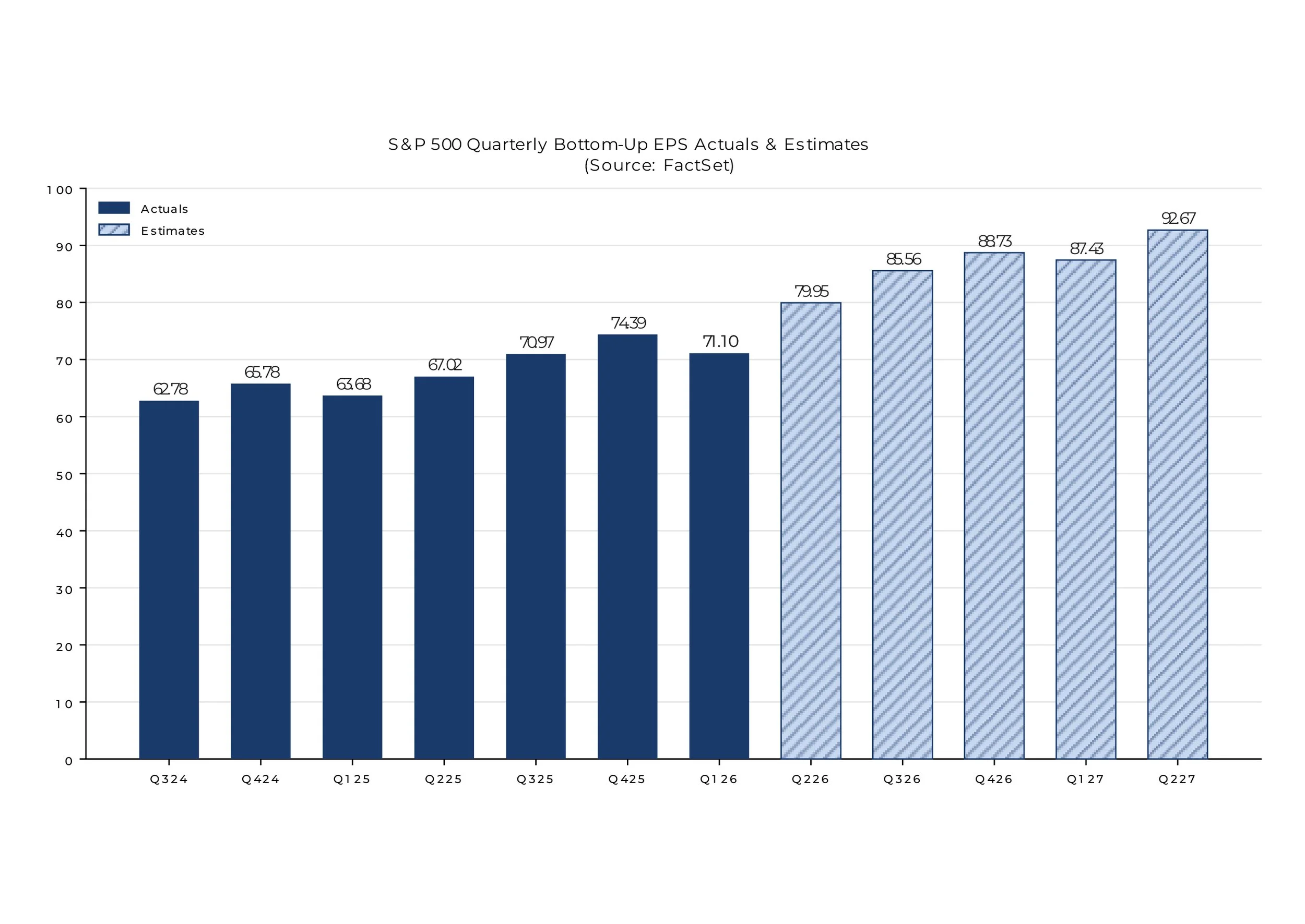
Even more encouraging, earnings growth is expected to broaden beyond the largest technology companies and become more widely distributed across the broader market. Excluding NVIDIA from the Magnificent Seven, the broader large-cap universe is expected to grow earnings by 16% in 2026, compared to 13% for the next six largest technology companies excluding NVIDIA.
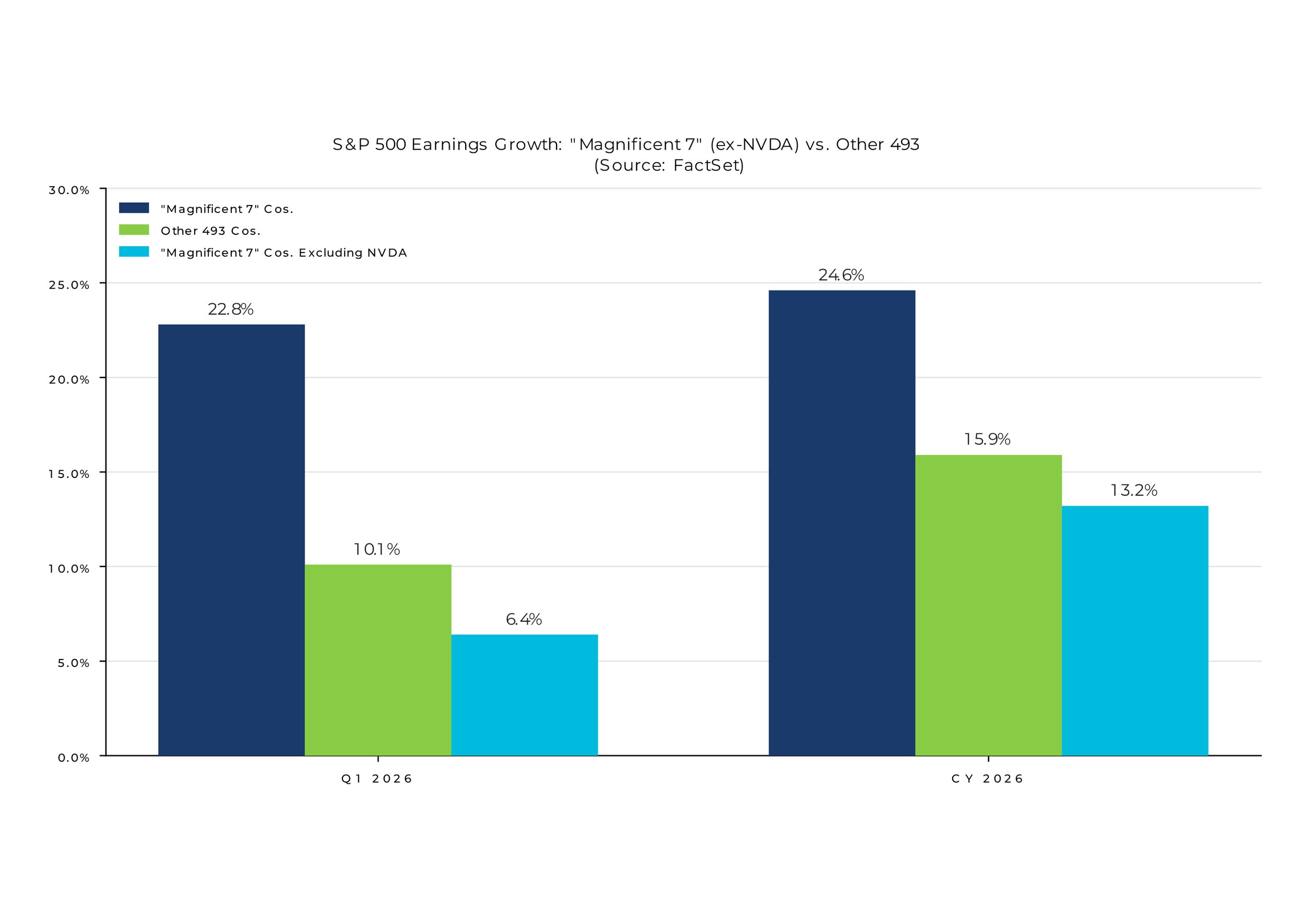
This broader participation would be a healthy development, as markets driven by a wider range of companies are generally less risky than highly concentrated markets dependent on a small number of stocks.
Of course, there is always the possibility that earnings growth disappoints. With valuations elevated and optimism high, that risk cannot be dismissed. Over the past 80 years, corporate earnings have grown at roughly 6% annually, so sustained 20% growth rates likely imply eventual disappointment. The challenge, as always, is that the timing is unknowable.
Risk on the Horizon
Looking forward, what could threaten returns?
Geopolitics remains the most obvious risk. Conflicts in Ukraine and the Middle East could escalate further, and the most significant geopolitical threat remains the possibility of China moving against Taiwan. Predicting these events with precision is nearly impossible, which is why avoiding uncompensated risk is generally wiser than trying to forecast the timing.
Higher inflation is probably the next major concern. Military conflicts, supply disruptions, and the high debt burdens of developed economies all increase the probability of sustained inflationary pressure. A meaningful and prolonged rise in inflation would negatively affect both equities and fixed income.
Equity valuations are another concern, particularly if AI-driven productivity gains result in greater consumer benefits through competition rather than significantly higher corporate profits. This risk is best managed by avoiding excessive concentration in the most expensive or speculative areas of the market.
Slower economic growth—whether caused by debt burdens, fiscal deficits, or geopolitical disruption—would also reduce expected returns for both equities and fixed income. While this appears to be a less immediate threat than geopolitics, inflation, or valuations, it remains important to monitor. In that environment, high-quality fixed income remains the best portfolio defense.
Investment Strategy and Outlook
With geopolitical risks elevated, diversification and disciplined rebalancing are more important than ever. Attempting to predict short-term outcomes in this environment is inherently unreliable.
We continue to advocate for broad diversification across asset classes:
Equities: While large technology companies remain expensive, their growth potential—particularly in artificial intelligence—supports maintaining some exposure. To balance this, we continue to diversify across other equity segments.
Fixed Income: We continue to emphasize mortgage-backed securities and selectively chosen corporate bonds. U.S. Treasuries provide important downside protection during risk-off periods, while municipal bonds offer attractive after-tax yields for taxable accounts.
Private Markets: Private investments can enhance returns but require careful consideration of liquidity constraints. We recommend these exposures only when investors have sufficient liquid assets and a clear understanding of the trade-offs involved. Manager selection remains especially important, particularly in credit-focused strategies.
Prudent asset allocation depends as much on risk management as it does on capturing opportunity. We continue to emphasize diversification, valuation discipline, and thoughtful portfolio construction to help navigate uncertainty and achieve long-term investment objectives.
Disclosure:
This content is for informational and educational purposes only. It is not intended as, and should not be considered, personalized investment advice or a recommendation to buy or sell any security. Innovia Wealth is an SEC-registered investment adviser; registration does not imply any level of skill or training. Innovia does not provide legal or tax advice—please consult the appropriate professional for those matters. All investments involve risk, including the potential loss of principal. Past performance is not a guarantee of future results. Content on this channel is intended for a U.S. audience. Advisory services are only offered to clients or prospective clients where Innovia Wealth and its representatives are properly licensed or exempt from licensure.