
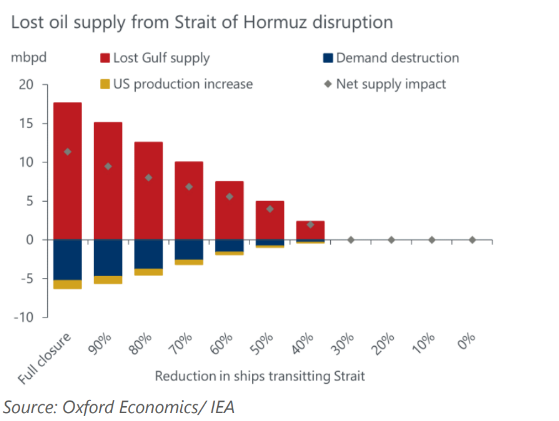
Oil prices have historically reacted quickly and often sharply to conflicts in the Middle East, largely because the region accounts for a significant share of global crude production and exports, particularly through key transit points like the Strait of Hormuz (see below chart). The magnitude and duration of the price response, however, depend on whether supply is actually disrupted or merely perceived to be at risk.
During the 1973 Arab–Israeli War, members of Organization of the Petroleum Exporting Countries (OPEC) imposed an oil embargo against the United States and other nations. This led to a dramatic supply shock and caused oil prices to roughly quadruple within months. It marked one of the most severe and prolonged oil price spikes in history because real barrels were removed from the market.
A similar dynamic occurred during the Iranian Revolution in 1979. Production in Iran fell sharply, triggering panic buying and another doubling of oil prices. Soon after, the Iran–Iraq War further disrupted output from two major producers, reinforcing volatility in global energy markets.
In 1990, when Iraq invaded Kuwait, sparking the Gulf War, oil prices spiked rapidly as markets anticipated prolonged disruption. Prices rose from roughly $20 per barrel to over $40 in a matter of months. However, once it became clear that coalition forces would likely restore supply and protect key infrastructure, prices retreated relatively quickly.
More recently, price reactions have often been shorter-lived unless physical supply is threatened. For example, during periods of tension involving Iran and threats to shipping lanes, prices have jumped on headlines but then eased when exports continued largely uninterrupted. Even during episodes like the 2003 Iraq War, oil prices rose into the conflict but fell once it became clear that large-scale supply destruction would not materialize.
In general, markets respond to Middle East conflict in three stages. First, there is a risk premium added almost immediately based on fear of disruption. Second, traders assess whether production, export terminals, or shipping chokepoints are actually affected. Third, if supply remains steady and spare capacity—often from Saudi Arabia or other OPEC members—is available, prices tend to stabilize or decline.
The current situation in the Middle East is still fluid, but OPEC has signaled it would be willing to increase production if needed and world leaders appear committed to keeping the Strait of Hormuz shipping lanes open—which should help to keep oil prices stabilized.
Historical Stock Impact
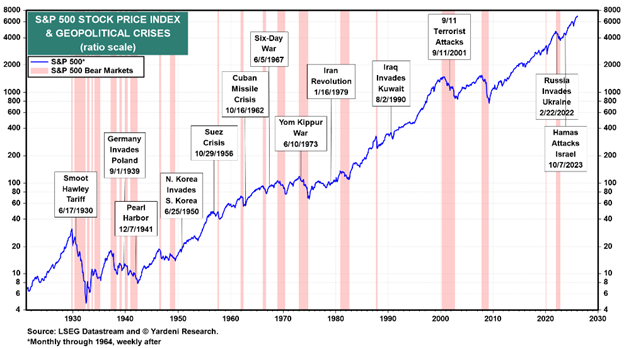
As for the overall stock market in response to geopolitical conflicts—the short-term reaction is often to sell risky assets such as stocks—but as the below table shows, stocks typically recover quickly as the vast majority of conflicts have little to no lasting economic impact on the US—and at this point we see no reason to think this time will be different.
Disclaimers:
This material is provided for informational and educational purposes only and does not constitute investment advice, a recommendation, or an offer or solicitation to buy or sell any security or investment strategy. Any opinions expressed are as of the date of publication and are subject to change without notice.
All investing involves risk, including the possible loss of principal. There can be no assurance that any investment strategy will be successful or that investment objectives will be achieved. Past performance is not indicative of future results.
Index performance is provided for illustrative purposes only. Indexes are unmanaged and do not reflect the deduction of advisory fees, transaction costs, or other expenses. Investors cannot invest directly in an index.
Any forward-looking statements, projections, or estimates are based on current assumptions and expectations and are subject to significant uncertainties and changes in market conditions. Actual results may differ materially.
This commentary is not intended to provide individualized investment advice and does not take into account the particular investment objectives, financial situation, or needs of any specific investor. Investors should consult with a qualified financial professional before making any investment decisions.